
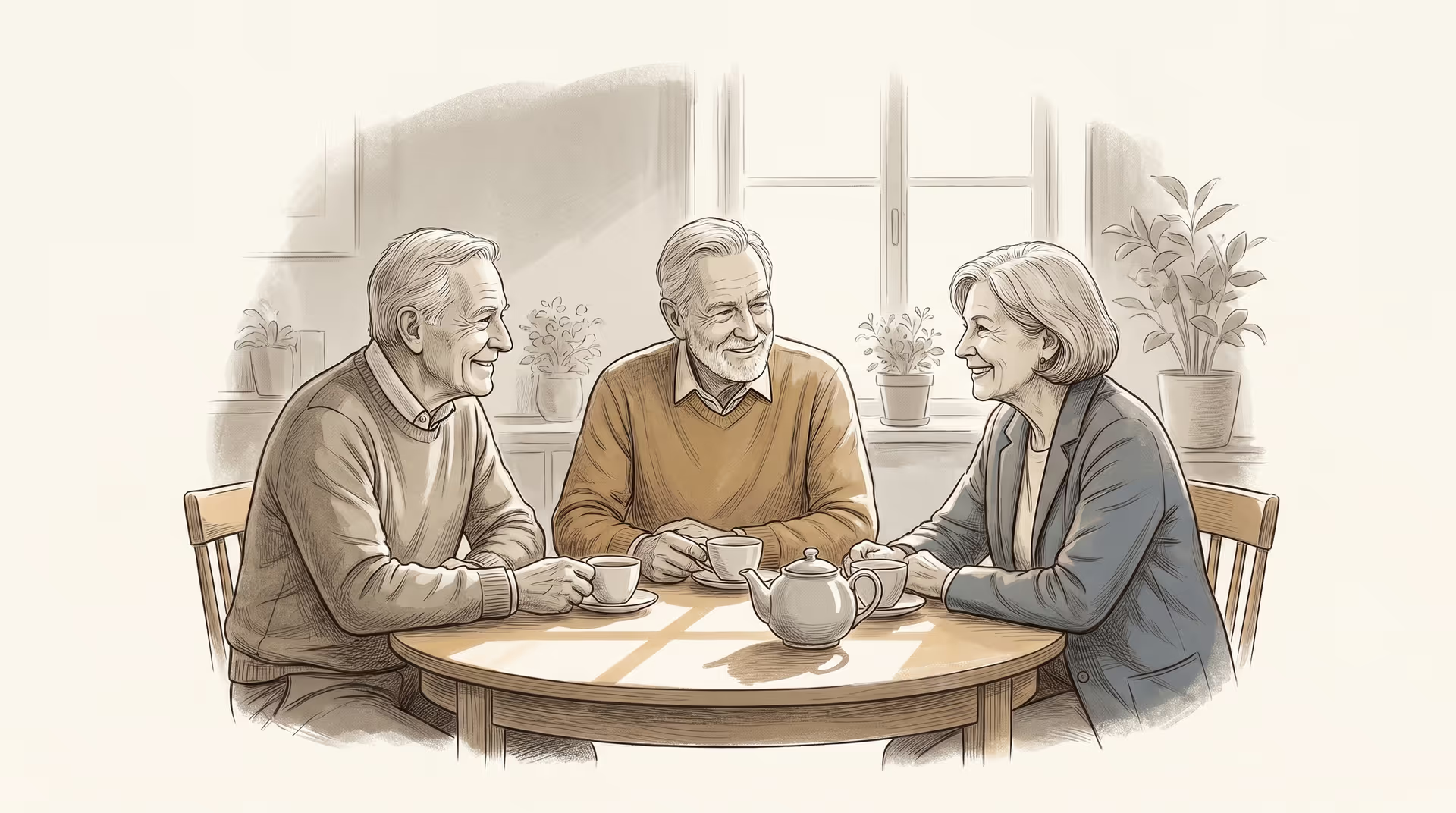
Loneliness is a signal: the mind's way of saying that a person's social needs are not being met. Many people mistake it for a personality trait or an inevitable part of growing older. For older adults, that signal deserves real attention, because the research treats isolation as a health condition on par with the risks we already take seriously, like high blood pressure or smoking.
There is a real difference between being alone and feeling lonely, and it matters for health. The quiet warning signs are easy to miss, but there are practical ways seniors and families can rebuild connection, including the role a community setting can play.
Loneliness and social isolation are not the same thing
The National Institute on Aging draws a useful distinction. Social isolation is objective: having few relationships, infrequent contact, and little engagement with others. Loneliness is subjective: the distressing feeling of being disconnected, regardless of how many people are around.
The two often overlap, but not always. Someone can live alone and feel perfectly content, while someone surrounded by family can still feel profoundly unseen. That nuance matters, because the fix is rarely "just add more people." It's about adding meaningful connection.
Why connection is a health issue
This is where the data is sobering. According to the Centers for Disease Control and Prevention, social isolation is associated with roughly a 50% increased risk of dementia and meaningfully higher risks of heart disease and stroke. The NIA's research overview links loneliness to higher rates of depression, anxiety, cognitive decline, and even premature death.
The mortality risk of chronic isolation is comparable to that of smoking. Researchers are still studying the mechanisms, but the practical takeaway is clear: protecting social connection is a legitimate part of preventive health, right alongside good nutrition and regular exercise.
Older adults face stacked risk factors: living alone after the loss of a spouse, retirement ending daily contact with colleagues, hearing or vision loss that makes conversation tiring, and reduced mobility that shrinks the world to a single home.
The signs of loneliness families often miss
Loneliness rarely announces itself. Many older adults won't say "I'm lonely"; they may not even recognize it, or may feel embarrassed to admit it. Instead, it shows up sideways. Use this checklist when you visit or call:
- Withdrawal from activities they used to enjoy: clubs, faith services, hobbies, phone calls
- Changes in sleep or appetite, or letting meals slide
- Neglected home or hygiene, a once-tidy space growing cluttered
- Increased reliance on TV or the phone as the main daily companion
- Low energy, sadness, or irritability that wasn't there before
- Talking at length during brief interactions, as if starved for conversation
- Reluctance to make plans, or saying "don't bother" about visits
- Worsening of chronic conditions without a clear medical cause
Any one of these can have another explanation. A cluster of them, persisting over weeks, is worth a gentle conversation, and possibly a chat with a doctor, since loneliness and depression can look alike.
How friendships change as we age, and why that's normal
Part of staying connected is adjusting expectations. Friendships in later life naturally shift. Lifelong friends move away or pass on, and the energy for a wide social circle often gives way to a preference for a few deep relationships. This narrowing is partly intentional: older adults tend to prioritize emotionally meaningful relationships over casual ones.
That's healthy, but it also means a few losses can hit harder, because each remaining tie carries more weight. The goal isn't to recreate a 30-year-old's calendar. It's to make sure a handful of genuine, reciprocal relationships stay nourished, and to be willing to form new ones.
Practical ways to stay connected
Connection rebuilds through small, repeatable habits more than grand gestures. The NIA and CDC both emphasize routine, low-barrier engagement:
| Approach | What it looks like | Why it works |
|---|---|---|
| Anchor a weekly routine | A standing Sunday call, a library class, a walking group | Predictability removes the "should I?" friction |
| Lead with a shared activity | A faith community, volunteering, a hobby club | Connection forms around doing, not just talking |
| Use technology as a bridge | Video calls, a class on email or messaging | Closes distance with far-away family |
| Address the barriers | Treat hearing loss, arrange transportation | Removes the friction that quietly ends socializing |
| Consider a pet | A dog or cat for those able to care for one | Daily companionship and a reason to get outside |
| Reconnect intentionally | Reach out to one lapsed friend per month | Re-warms relationships that simply went quiet |
For those who can no longer drive, transportation is often the hidden obstacle, and the federal Eldercare Locator can connect families to local rides, senior centers, and meal programs in their area. Sometimes companionship comes from an unexpected place: a well-suited pet can ease isolation and add structure to the day.
How community living helps
For some older adults, the most effective answer to isolation is a change of environment. A home that once held a full life can become a place of solitude, especially after a loss or a decline in driving.
Senior living communities are designed around connection. Shared dining turns eating (often a lonely act for someone living alone) into a daily social touchpoint. Built-in activities, common spaces, and neighbors a few steps away lower the barrier to engagement to nearly zero. Many residents who move into assisted living describe the social rhythm as the most unexpected benefit, more than the care itself.
This is not the right path for everyone, and it shouldn't be framed as the only solution. But for an older adult who has grown isolated at home, the question is worth asking honestly: is the house serving them, or keeping them alone?
A note for families
If you're worried about a parent or loved one, start with curiosity rather than a verdict. Ask what a good day looks like now, and what's gotten harder. Loneliness responds to being noticed. Often the most powerful intervention is simply showing up consistently, and helping remove whatever quiet barrier has been standing in the way.
Frequently asked questions
Is loneliness really a health risk, or just unpleasant? It's a genuine health risk. The CDC associates chronic social isolation with substantially higher rates of dementia, heart disease, and stroke, and the NIA links it to depression and shorter lifespan. It is comparable to other major risk factors.
My parent insists they're "fine alone." How do I know if it's a problem? Watch behavior over words. Withdrawal from former activities, declining self-care, disrupted sleep or appetite, and low mood that lasts for weeks are more telling than what someone says. A cluster of those signs warrants a gentle conversation and possibly a medical check, since loneliness and depression overlap.
Does moving to a senior community guarantee they'll be less lonely? No guarantee (connection still takes willingness), but communities are structured to make it far easier, with shared meals, daily activities, and nearby neighbors that remove the effort of seeking people out.
Where can we find local programs and transportation? The Eldercare Locator (eldercare.acl.gov), a free public service, connects families to senior centers, meal programs, ride services, and other local resources by ZIP code.
