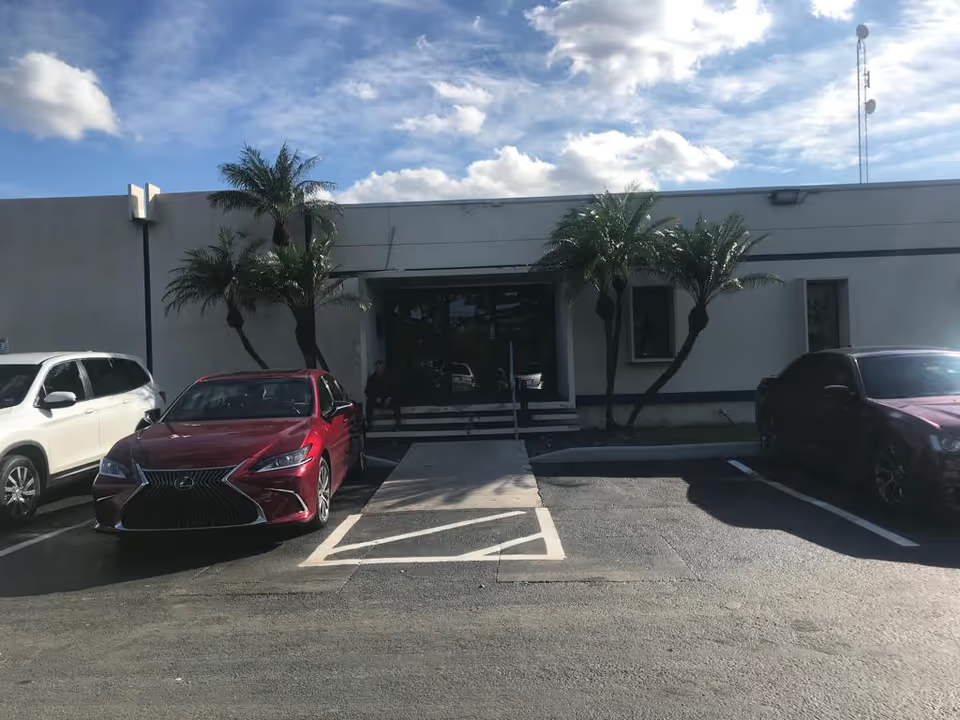
Overall impression Continuum Care of Miami is described most often for its clinical compassion and hospice expertise. Families and clients repeatedly characterize nurses, aides, and the interdisciplinary team as warm, respectful, and attentive, and the agency receives particular praise for end-of-life support, emotional accompaniment, and the involvement of social work and chaplain services. Many accounts emphasize personalized, dignity-focused care and a smooth hospice enrollment experience that brought relief to families.
Caregiver quality Caregiver quality is a clear strength where present: clinical staff are frequently described as professional, knowledgeable, and emotionally supportive. Reviewers highlight examples of attentive nurses and aides, and several comments single out the effectiveness of hospice-oriented care teams. That said, praise for individual staff is sometimes juxtaposed with mentions of variability in performance across caregivers; this points to generally high-caliber care in many placements but inconsistent experience depending on the assigned personnel.
Communication and responsiveness Communication impressions are mixed. Numerous notes describe responsive office communication, follow-up after a client’s passing, and helpful guidance from care managers. Conversely, there are repeated accounts of breakdowns between the office and field staff, which affected expectations about visits and task completion. These communication gaps appear to be an operational issue rather than a consistent reflection of clinical skill.
Reliability, scheduling, and coordination A recurring operational weakness involves reliability of shift coverage and schedule management. Reviews include references to missed or incomplete shifts, incomplete task lists during scheduled hours, and broader coordination problems that required family intervention. These items suggest the agency may struggle at times with staffing logistics, caregiver assignment consistency, and shift continuity—issues that can materially affect day-to-day caregiving even when individual caregivers perform well.
Value and management Many families express gratitude and consider the care high value—especially for hospice and end-of-life services that combine clinical competence with emotional support. At the same time, management-level concerns emerge in the areas of scheduling, training consistency, and office-field coordination. These operational gaps have led to isolated instances of professionalism and safety concerns; prospective clients should assess supervisory processes and escalation pathways when evaluating the agency.
Notable patterns and practical advice Patterns in the feedback point to strong hospice capability and a compassionate culture supported by social work and chaplain involvement, balanced against operational variability in scheduling and training. When considering Continuum Care of Miami, families may wish to: confirm guaranteed shift coverage and contingency plans, ask about caregiver training and turnover, request a primary caregiver or continuity plan, and clarify communication and escalation procedures. Doing so can help preserve the agency’s clinical strengths while mitigating the operational risks noted by several families.